05 October 2026
Ikat – A Craft That Tells You Where It Comes From

Ikat is one of the oldest weaving techniques in the world, and one of the most widespread. You find it in Central Asia, Japan, India, Guatemala, Indonesia. The word itself comes from the Malay-Indonesian mengikat: to tie, to bind.
UNESCO notes that Ikat most likely developed independently across different cultures, with no single point of origin. And yet the patterns always tell you immediately where a piece comes from. Every region, every village, every weaver leaves a different mark.
The blurred edge is the signature of the hand.
At SoRarePieces, we source Ikat textiles from different partners, each with their own story and their own visual language. Light, fine, fluid scarves. And heavier pieces with real presence.
WHAT IS IKAT?
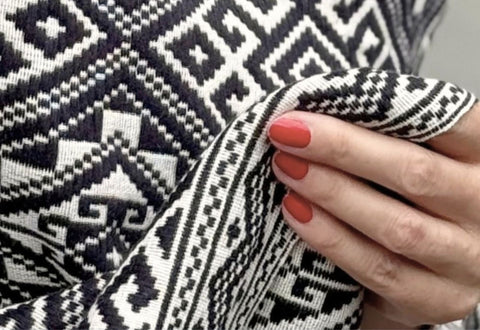
Ikat is a resist-dyeing technique. The pattern is not printed or embroidered onto the fabric. It is dyed into the threads themselves, before a single one of them reaches the loom. That's why an Ikat fabric is patterned on both sides, and why its edges always seem to breathe a little.
WARP, WEFT AND DOUBLE IKAT
There are three kinds of Ikat, depending on which threads carry the pattern:
- Warp Ikat: only the warp threads, stretched lengthwise on the loom, are tied and dyed. The weft is a solid color.
- Weft Ikat: the pattern sits in the weft threads and only appears as the weaver works. Thai Mudmee is a weft Ikat.
- Double Ikat: both warp and weft are tied and dyed, and the weaver has to bring them together exactly. It is the most difficult and the most expensive form, made in only a few places, like Patan in India (patola), the village of Tenganan on Bali (geringsing) and Okinawa in Japan.
HOW DOES IKAT WORK?
Ikat does not begin at the loom but long before: every single cotton thread is tied and dyed by hand, layer by layer, color by color. Only then does it reach the loom.
The result is a soft blurring at every edge of the pattern. It is the signature of Ikat, the proof that this particular pattern exists exactly once.
Before the scarf, there is the loom. Before the loom, there is the thread.

MUDMEE: IKAT IN THAILAND
In Thailand, this technique is called Mudmee, also spelled matmi or mudmi. The name means "tied threads". It has been passed down through generations of women and was historically worn for ceremonies, festivals and special occasions.
Mudmee is woven in almost every province of Isaan, the northeast of Thailand, such as Khon Kaen, Roi Et, Surin, Buri Ram and Si Sa Ket, and in many provinces of central Thailand. It is made from silk or cotton. Queen Sirikit The Queen Mother did a great deal to keep Mudmee alive and bring it back into everyday use.
Nantana is an older woman who knows a great deal about Ikat. Her family has practised this craft in Isaan, the northeast of Thailand, for generations, and she loves passing it on, including to travellers who are genuinely curious. But many people simply don't know it, she says. Or they don't have the patience and the dexterity. You have to learn it.

LIGHT OR HEAVY: HOW TO USE IKAT
The lighter Ikat pieces make beautiful scarves, for a special occasion or simply as a beloved everyday piece. The heavier ones lend themselves wonderfully to other uses: home décor, cushion covers, bed throws, or a wall piece.

OUR IKAT PIECES FROM THAILAND
Light and fluid, approx. 150 × 200 cm:
- Ikat Cotton Scarf · Lime Green & Yellow
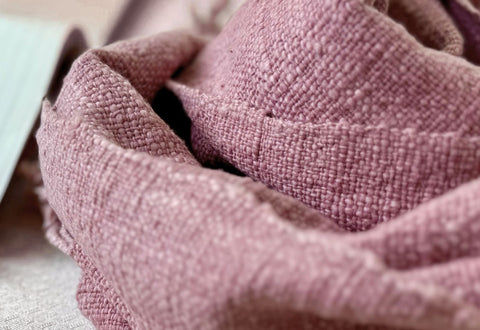
- Ikat Cotton Scarf · Pink
- Ikat Cotton Scarf · Soft Pink & Sky Blue
Heavier, with real presence, approx. 200 × 150 cm:
FREQUENTLY ASKED QUESTIONS
What does the word Ikat mean?
Ikat comes from the Malay-Indonesian word mengikat, meaning to tie or to bind. It describes the core of the technique: threads are tied before they are dyed.
What is Mudmee?
Mudmee (also matmi or mudmi) is the Thai name for weft Ikat and means "tied threads". The weft threads, silk or cotton, are tied and dyed by hand, then woven on a traditional loom. It is mainly made in Isaan, the northeast of Thailand.
What is the difference between Ikat and batik?
Both are resist-dyeing techniques, but at different stages. In batik, wax is applied to a finished fabric before dyeing. In Ikat, the threads are tied and dyed before the fabric is even woven.
What is double Ikat?
In double Ikat, both the warp and the weft threads are tied and dyed before weaving. It is the most difficult and most expensive form of Ikat, made for example in Patan (India), Tenganan (Bali) and Okinawa (Japan).
Why are the edges of an Ikat pattern blurred?
Because the pattern is dyed into the threads before weaving, it is extremely difficult for the weaver to line up the dyed threads perfectly on the loom. That soft blur is the signature of handmade Ikat.
How do I care for an Ikat cotton scarf?
Hand wash with mild detergent, wash separately, and hang to dry in the shade.
DISCOVER THE PIECES
→ Shop the collection: Scarves & Textiles
→ Read more: What is Khit weaving?
→ And: Colors the Earth Gives – Plant Dyes and Handspun Cotton from Thailand
→ See the fabrics in motion: Follow @sorarepieces
FURTHER READING
→ Textiles and Clothing along the Silk Roads, the UNESCO publication referenced in this article, is available free of charge from UNESCO.
→ For those who want to go deeper: Global Ikat: Roots and Routes of a Textile Technique, edited by Rosemary Crill, traces the global story of this technique, from Japan to Central America, from India to Southeast Asia.
→ And for the broader world of textile exchange: Global Textile Encounters by Marie-Louise Nosch, Zhao Feng and Lotika Varadarajan is a beautifully readable introduction.
Rare Finds. Real People.