03 October 2026
Gifts for People Who Love Other Cultures – 4 Handmade Pieces from Real Makers

Ever bought a "handmade" souvenir and found a factory sticker on the back? Oh yes? So this guide is the opposite: four gifts, four places and four real makers. And I can tell you where each piece comes from, because we buy directly from the people who create them, and I know most of them personally.
WHAT MAKES A CULTURAL GIFT MEANINGFUL?
A meaningful cultural gift is made by a person you can name, in a place you can find on a map, with a technique that belongs to that place. It carries the culture itself: the craft, the motifs, the hands. People who love other cultures notice the difference right away, and they keep these pieces for years.

1. FOR THE FRIEND WHO LOVES PORTUGAL: HAND-PAINTED AZULEJOS
In Portugal, history lives on walls. Blue and white tiles everywhere: on facades, in stairwells, at train stations. In the Minho region in the north, Maribel paints them by hand. She came to Portugal from Cuba, fell in love with azulejos, and noticed that one workshop after another was closing. So she opened her own studio.
For us, she designed a small collection in classic cobalt blue on white: Sol, Flor, Conchas, Pássaro, Peixe. Each one is painted brushstroke by brushstroke. On the coffee table as a coaster or leaning on a bookshelf, it will start a conversation sooner or later.
A good pick for: Portugal lovers, anyone with a blue-and-white kitchen, people who collect small things with meaning.
→ Shop the collection: Azulejo Tiles & Coasters
→ Read the story: Tiles from Northern Portugal

2. FOR THE TEXTILE LOVER: A HANDWOVEN SCARF FROM THAILAND OR LAOS
In Isaan, northeastern Thailand, women weave Khit: patterns that seem to float above the fabric, built thread by thread at the loom. The diamond motifs traditionally stand for protection and for belonging to a village community. Our partner Pla selects the pieces with us, and when we want to know what a motif means, she asks the elder women in the village first.
You'll also find Ikat scarves in our shop, where every thread is tied and dyed by hand before it ever reaches the loom, handspun cotton scarves dyed with plants, and Naga table runners woven from mulberry fiber in Laos.
A good pick for: textile lovers, slow fashion fans, anyone who likes to wrap themselves in something with a story.
→ Shop the collection: Scarves & Textiles
→ Read more: What is Khit weaving?

3. FOR THE ONE WHO LOVES NATURAL, EARTHY THINGS: A KRAJOOD BOX
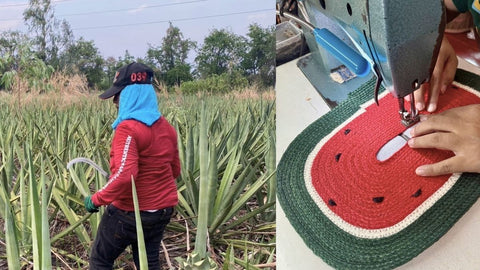
Krajood is a grey sedge from the freshwater wetlands of Southern Thailand, often sold as seagrass. Phanchaya's family, her mother and sisters, weave it on the floor with hands and feet, faster than you can follow. Their lidded boxes are perfect for jewelry, keys or tea, and they're the heart of our Thai Spa Ritual gift box with handmade soap.
Small batches only: it's one family, weaving by hand. The first round sold out fast.
A good pick for: natural material fans, people who love calm and tidy spaces, anyone trying to buy less plastic.
→ Shop: Bags & Baskets and Self-Care & Wellness Sets
→ Read the story: Handwoven Seagrass Bags & Boxes

4. FOR THE ONE DRAWN TO FAR-OFF PLACES: FISH LEATHER FROM KENYA
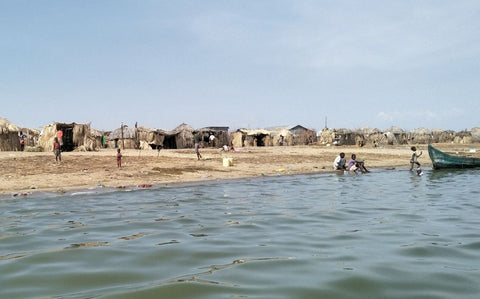
At Lake Turkana in northern Kenya, the world's largest desert lake, Ira and James Ambani turn Nile perch skin, a byproduct of fishing, into leather. Their workshop now employs around 20 people across two locations, most of them women. The scale pattern stays visible, and the leather is light and surprisingly strong.
Earrings, a bangle, a key fob or a wallet: fish leather is still rare, so most people have never held it. Expect the question: "Wait, this is fish?"
A good pick for: lovers of unusual jewelry, travelers, anyone who already has everything.
→ Shop the collection: Fish Leather Accessories
→ Read more: What Is Fish Leather?
HOW TO SPOT THE REAL THING: A QUICK CHECKLIST
- There's a name. Who made it, where, and how? "Ethically sourced worldwide" without any details is a red flag.
- The technique is named. Hand-painted, handwoven, hand-dyed, ideally with the regional name: azulejo, Khit, Ikat.
- It isn't perfect. A slightly uneven edge, a small shift in color. That's the hand of the maker.
- The story checks out. Real makers live in real places. You can look them up.
WHERE TO FIND THEM
Every piece in this guide was chosen by us and bought directly from the makers or through partners we know personally.
FREQUENTLY ASKED QUESTIONS
What is a good gift for someone who loves other cultures?
A handmade piece from a maker you can name, made with a technique from that region. For example hand-painted azulejos from Portugal, a Khit scarf from Thailand, or fish leather jewelry from Kenya.
How can I tell if a cultural gift is authentic?
Look for the maker's name, the place and the technique. Small irregularities are a good sign: they show the piece was made by hand.
Do you offer gift wrapping?
Yes, and it's free. Send us a message at hallo@sorarepieces.com and we'll wrap your order by hand.
Rare Finds. Real People.